> ## Documentation Index
> Fetch the complete documentation index at: https://help.nextmatter.com/llms.txt
> Use this file to discover all available pages before exploring further.
# Instance visibility
> Choose who can see each instance of a workflow. You can keep instances public, limit them to the people involved, or restrict them to selected teams.
Decide who can see each running instance of a workflow, so the right people stay in the loop.
Instance visibility works together with folder and workflow visibility. For those settings, see [Workflow visibility](/docs/about-visibility-and-permissions).
## Who can see an instance
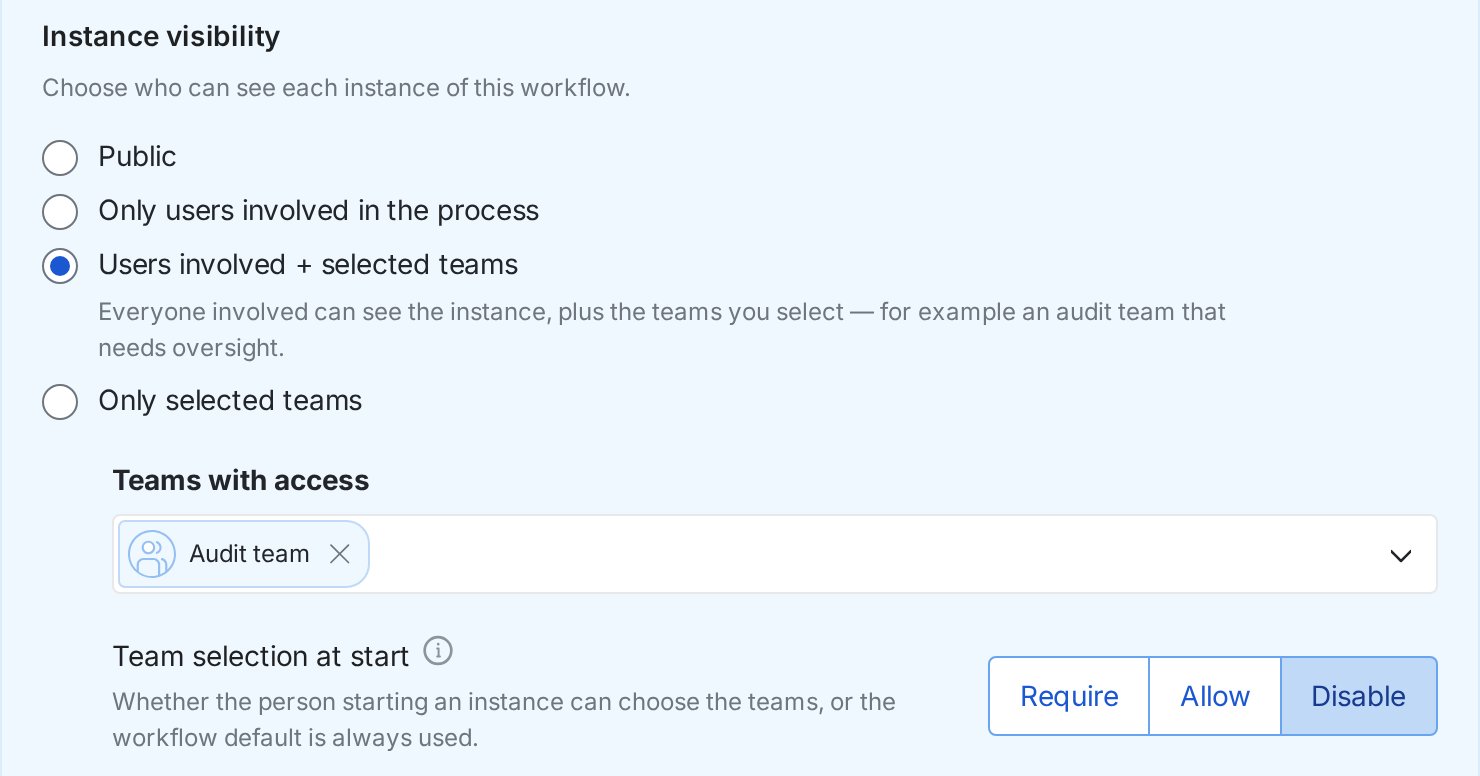
You can choose one of the following:
* **Public** - everyone with access to this workflow can see its instances
* **Only users involved in the process** - only people working on an instance, its assignees and their teams, can see it
* **Users involved + selected teams** - everyone involved can see the instance, plus the teams you select. Use this when an audit team needs oversight without being assigned to a step
* **Only selected teams** - only the teams you select can see the instance, no matter who is involved. If a step needs someone outside those teams, that person can view and complete their own step, but nothing else
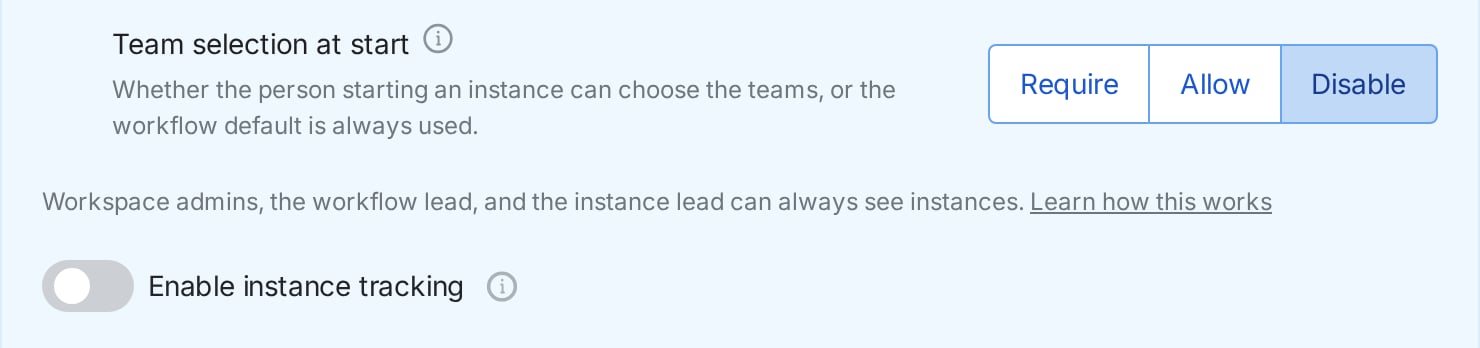
Workspace admins, the workflow lead, and the instance lead can always see instances.
Access to the folder is not enough to see a private instance. Folder members (owner, team, read, or edit) don't see other people's work on that instance in instance tables or **Actions**. If a step is assigned to you, that task still shows. For details, see [Workflow visibility](/docs/about-visibility-and-permissions#folder-visibility).
You can further restrict access by managing which teams have access to the folder the workflow is created in. For details, see [Workflow visibility](/docs/about-visibility-and-permissions).
**Use case**: You run one client onboarding workflow for several clients. Set instance visibility to **Only selected teams**, and set **Team selection at start** to **Require**. The person starting the instance picks the client team. Only that team can see the instance. If a later review step is assigned to someone outside the client team, they can complete their own step and nothing else.
If an audit team needs to see every instance without being assigned to a step, use **Users involved + selected teams** and add the audit team to **Teams with access**.
## Set who can see each instance
1. Open a workflow in the workflow builder.
2. Open **Workflow start options** and, under **Instance visibility**, select who can see each instance.
3. If you selected **Users involved + selected teams** or **Only selected teams**, choose the **Teams with access**. For **Only selected teams** with **Team selection at start** set to **Disable**, you must select at least one team.
4. Set **Team selection at start**.
5. Publish the workflow.
The **Enable instance tracking** toggle sits right below **Instance visibility**. It lets external users follow instance progress with a public link.
Selecting **Only selected teams** turns off **Enable instance tracking** and you can't turn it back on — those instances don't get a public tracking link. For details, see [Enable instance tracking](/docs/let-an-external-user-start-a-process#enable-instance-tracking).
 ### Team selection at start
This setting is available when you use a team-based option. It controls whether the person starting an instance can choose the teams, or the workflow default is always used.
* **Require** - the person starting the instance must select the teams
* **Allow** - the person starting the instance can change the workflow's default teams
* **Disable** - the workflow default teams are always used
Teams used as **Teams with access** don't need an inbox. They can act as access groups only.
For details, see [Build teams](/docs/build-teams).
If your workspace requires a minimum visibility option, options below that minimum are unavailable. You'll see *Your workspace requires at least \[option] visibility.* To set a workspace minimum, contact our Support team.
## When you can't publish
You can't publish if a start that can't pick teams would have no one who can see the instance.
You can still save a draft. Warnings don't block publish.
**Only selected teams** with **Disable** and no default team also blocks a normal manual publish, even with no recurring start and no portal. Someone has to set at least one team.
### Recurring workflows and portals
A recurring start and a portal start can't choose teams. They use the workflow's default teams.
You can't publish when either is set and:
* **Team selection at start** is **Require**, and visibility is **Users involved + selected teams** or **Only selected teams**
* Visibility is **Only selected teams** and no default team is set, no matter what **Team selection at start** is
To publish, remove the recurring start or the portal, or give the start a way to get teams: switch off **Require**, or set a default team for **Only selected teams**.
**Require** left on **Public** or **Only users involved in the process** does not block publish. Those options have no team picker.
## Start an instance
When **Team selection at start** is **Allow** or **Require**, the start form shows **Teams with access**.
If the setting is **Require** on a team-based option, you must select at least one team before you can start the instance.
You can also start instances with API and pass `visibility_teams` (a list of team IDs). For details, see [API reference](/reference/instances_create).
Webhook and file-import starts use the workflow default teams. They don't accept a per-instance team selection.
If the workflow is already published, you can't start an instance in the same cases:
* **Require** on **Users involved + selected teams** or **Only selected teams**, and no teams were supplied and no default teams exist
* **Only selected teams** with no team at all
**Users involved + selected teams** can start with no teams. The people involved still see the instance.
## Find the right instances
In **Workflows > Overview**, you can add the **Visibility** and **Teams with access** columns and filter by them.
### Team selection at start
This setting is available when you use a team-based option. It controls whether the person starting an instance can choose the teams, or the workflow default is always used.
* **Require** - the person starting the instance must select the teams
* **Allow** - the person starting the instance can change the workflow's default teams
* **Disable** - the workflow default teams are always used
Teams used as **Teams with access** don't need an inbox. They can act as access groups only.
For details, see [Build teams](/docs/build-teams).
If your workspace requires a minimum visibility option, options below that minimum are unavailable. You'll see *Your workspace requires at least \[option] visibility.* To set a workspace minimum, contact our Support team.
## When you can't publish
You can't publish if a start that can't pick teams would have no one who can see the instance.
You can still save a draft. Warnings don't block publish.
**Only selected teams** with **Disable** and no default team also blocks a normal manual publish, even with no recurring start and no portal. Someone has to set at least one team.
### Recurring workflows and portals
A recurring start and a portal start can't choose teams. They use the workflow's default teams.
You can't publish when either is set and:
* **Team selection at start** is **Require**, and visibility is **Users involved + selected teams** or **Only selected teams**
* Visibility is **Only selected teams** and no default team is set, no matter what **Team selection at start** is
To publish, remove the recurring start or the portal, or give the start a way to get teams: switch off **Require**, or set a default team for **Only selected teams**.
**Require** left on **Public** or **Only users involved in the process** does not block publish. Those options have no team picker.
## Start an instance
When **Team selection at start** is **Allow** or **Require**, the start form shows **Teams with access**.
If the setting is **Require** on a team-based option, you must select at least one team before you can start the instance.
You can also start instances with API and pass `visibility_teams` (a list of team IDs). For details, see [API reference](/reference/instances_create).
Webhook and file-import starts use the workflow default teams. They don't accept a per-instance team selection.
If the workflow is already published, you can't start an instance in the same cases:
* **Require** on **Users involved + selected teams** or **Only selected teams**, and no teams were supplied and no default teams exist
* **Only selected teams** with no team at all
**Users involved + selected teams** can start with no teams. The people involved still see the instance.
## Find the right instances
In **Workflows > Overview**, you can add the **Visibility** and **Teams with access** columns and filter by them.
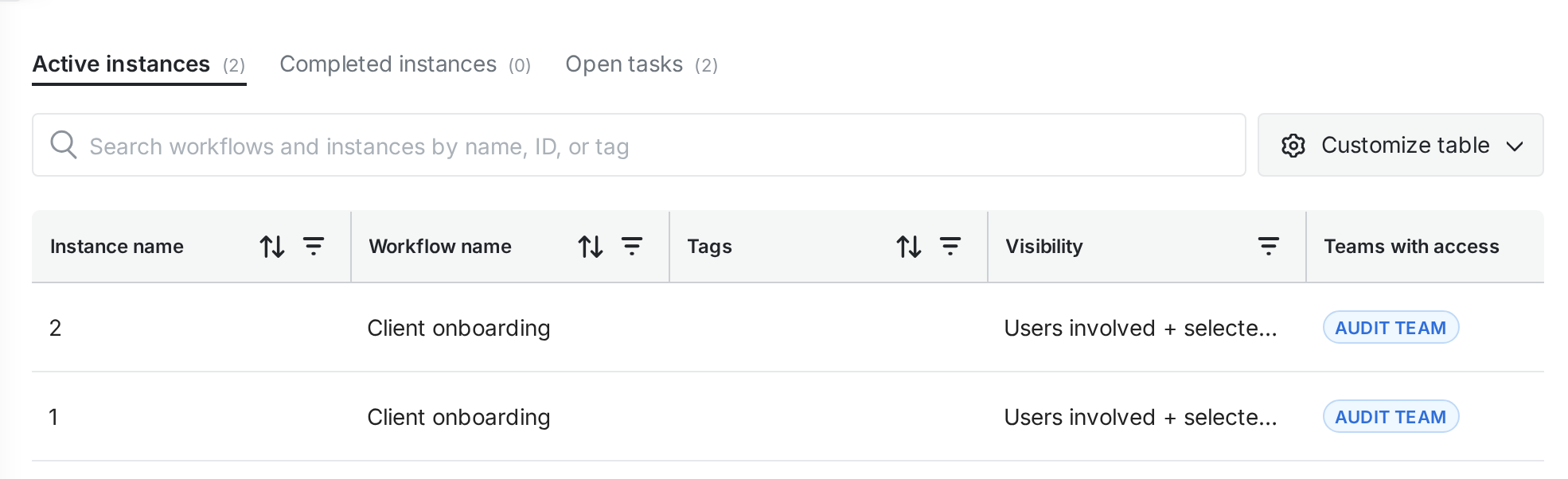 * **Visibility** - filter by the visibility option used for the instance
* **Visible to team** - instances whose **Teams with access** include that team
* **Visible to user** - instances whose selected teams include that person. This is not a list of every instance the person can open. Public and involved instances they can see as a colleague, assignee, or lead are not included unless they are on a selected team
The **Visible to user** filter is available to admins.
For details, see [Instance overview table](/docs/work-with-process-overview).
## Need to add a team later?
As an admin, you can add or remove **Teams with access** after the instance has started. You do this in **Edit instance settings**, the same place you edit the instance name.
1. In the workflow overview, click the instance.
2. Click **Edit instance settings**.
3. Update **Teams with access**.
The visibility option stays the same.
Adding or removing someone from a visibility team changes their access to those instances immediately. And if a step is assigned to someone who can't see an **Only selected teams** instance, they still get the task in their [inbox](/docs/inbox) and can complete that step, but can't open the instance, the timeline, other steps, or the instance row in the instance table. Task assignment notifications still go to the step assignee; instance-level notifications go only to people who can see the instance.
Instance visibility adds a layer on top of folder, workflow, and [step visibility](/docs/set-visibility-for-a-step). It does not replace them.
This documentation is built and hosted on [Mintlify](https://mintlify.com), a developer documentation platform.
* **Visibility** - filter by the visibility option used for the instance
* **Visible to team** - instances whose **Teams with access** include that team
* **Visible to user** - instances whose selected teams include that person. This is not a list of every instance the person can open. Public and involved instances they can see as a colleague, assignee, or lead are not included unless they are on a selected team
The **Visible to user** filter is available to admins.
For details, see [Instance overview table](/docs/work-with-process-overview).
## Need to add a team later?
As an admin, you can add or remove **Teams with access** after the instance has started. You do this in **Edit instance settings**, the same place you edit the instance name.
1. In the workflow overview, click the instance.
2. Click **Edit instance settings**.
3. Update **Teams with access**.
The visibility option stays the same.
Adding or removing someone from a visibility team changes their access to those instances immediately. And if a step is assigned to someone who can't see an **Only selected teams** instance, they still get the task in their [inbox](/docs/inbox) and can complete that step, but can't open the instance, the timeline, other steps, or the instance row in the instance table. Task assignment notifications still go to the step assignee; instance-level notifications go only to people who can see the instance.
Instance visibility adds a layer on top of folder, workflow, and [step visibility](/docs/set-visibility-for-a-step). It does not replace them.
This documentation is built and hosted on [Mintlify](https://mintlify.com), a developer documentation platform.